Kindergarten (KG)
The Kindergarteners spent several classes learning how to count in Spanish. Many of them know how to rote count beyond 10, but the trick is to mix up the numbers. We played many counting games with the mixed-up numbers to 5. After numbers, the students listened to several books about a familiar dog named Bizcocho (Biscuit)! As in a true immersive classroom, students completed a variety of differentiated language arts activities around the vocabulary and comprehension skills related to the stories.
First Grade (1K)
The focus for this month has been on Animales. The first graders first learned vocabulary associated with pets. Then we read the book Martí y el mango (Marty and the Mango) where they expanded the vocabulary to include more animals as well as the different frutas (fruits) that Martí's friends introduced in the book. Of course, we could not learn about mangos, cocos y guayabas without actually tasting mangos, coconuts and guavas!
Second Grade (2D)
The second graders have been busy preparing for the trip to España! They spent the first part of the month learning the vocabulary associated with the different articles of ropa (clothing) and then making the clothing out of paper to pack in their maletas (suitcases). After identifying their travel plans on a map of España, they were ready to travel! On February 24, they checked in at the aeropuerto where Mrs. McCrimmon stamped their pasaportes and Mrs. Dubé checked them through Security. The students found their asientos (seats) and the plane took off for Madrid! At the next class, the students found their places on an autobús for a video trip through Spain's capital. They learned key travel vocabulary words as well as a few significant sites in Madrid! March will bring more travel adventures!
Third Grade
The third graders also learned more about España this month. The students watched an informative video about the life of a Spanish girl and they also rotated through a variety of different centers to learn more about Spain. The centers included working on the Chromebooks to access the Time For Kids - Spain website where they learned information about Spain's sites, history and daily life of a student. They also researched "Fast Facts" about Spain, made the Spanish flag and studied the geography of Spain by working on a map.
Fourth Grade
The fourth graders took the study of Spain to a new level by focusing on its culture. First they learned the vocabulary associated with a culture study of a country. Then they each chose a topic to research for a class book about España. Each student contributed a page to the book. They had to use books and websites to research a minimum of 10 facts and record their sources. Once the research was complete, they organized their facts into a one or two paragraph essay where they practiced writing interesting topic sentences and conclusions. The final result is an impressive book!
Fifth Grade
After wrapping up their study of the face and body vocabulary with a final test at the beginning of the month, the fifth graders also moved on to a study of Spain. They began their study with a video tour of the major travel destinations in Spain. They are using the information learned in the video tour plus information from travel books and websites to create their own 7-day itinerary of a trip to Spain! The end result will be an authentic three-fold brochure complete with daily sites and photos. Stay tuned because the end result looks like a travel brochure from a travel agent! Be sure to talk to a 5th grader if you are planning a trip to Spain!
Friday, March 4, 2016
Friday, February 5, 2016
January - Off to a Busy Semester!
Kindergarten (KG)
The Kindergarteners have started their first semester of Spanish! They began by learning how to greet people and ask and answer the questions ¿Cómo estás? (How are you?) and ¿Cómo te llamas? (What's your name?) They also learned some of the colors in Spanish by singing songs and painting.
First Grade (1K)
The first graders also began with a study of greetings and polite words. (It's always a good idea to know how to say por favor (please) and gracias (thank you) in any language!) They also played games, sang songs and learned the vocabulary for numbers. They all know how to rote count past 20, but the hard part is knowing the numbers out of order!
Second Grade (2D)
The second graders started the semester adding more greeting and polite word phrases to their knowledge base. They now know enough to present a short skit to their friends. They will need some of these phrases for their imaginary trip to Spain! They are getting ready for their trip by making their own pasaportes, billetes (tickets) and maletas (suitcases) for the trip! Stay tuned because the departure day is February 24!
Third Grade
The third graders have been working on Capítulo 3 & 4 for their "A Day in the Life..." style books. Capítulo 3 focused on ropa (clothing) vocabulary and Capítulo 4 focused on mandatos (classroom commands). They practiced the vocabulary in a variety of differentiated centers including using iPads to access QR codes of different articles of clothing (pictured below). The third graders had the experience of taking their second Spanish test in class. They all did a fantastic job reviewing the words at home with the help of Quizlet (a vocabulary review website)!
Fourth Grade
The fourth graders have just finished a unit on calendario (calendar), estaciones (seasons) and tiempo (weather) vocabulary. Besides learning isolated words or phrases, they learned how to ask and answer questions using the vocabulary. They all enjoyed working on a Powerpoint slide project where they had to find images of holidays, weather and seasons and then use their vocabulary to describe the images (see below).
Fifth Grade
The fifth graders have also just finished a unit on cuerpo (body) and cara (face) vocabulary. They took their vocabulary to the next level by writing paragraph descriptions of imaginary monsters. They used their past knowledge of adjectives, colors, shapes and numbers to create interesting monstruos. They then described their monstruos in an oral presentation to the class. Take a look at an example below.
It has been a great start to the new year! I am so proud of the work that ALL of the Spanish students from Kindergarten through 5th grade have done!
Thursday, January 7, 2016
New Term Begins with El día de los Reyes!
It’s back to school and the K-2 students are
switching to their second language for the second semester!
The Kindergarteners in Mrs. George’s class and
the first graders in Mrs. Krochmal’s class had a special treat because they
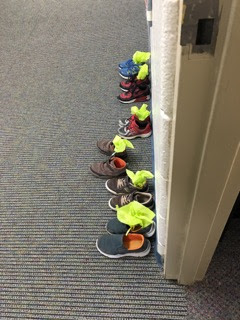
started the year with the January 6th holiday of El día de los Reyes
(Three King’s Day). This is the day that
Hispanic children throughout the world set out their shoes on the doorstep to
wake up to presents brought by the three kings.
So keeping with tradition, the KG and 1K students left their zapatos (shoes) in the hallway at the
beginning of class. After learning about
the holiday and making coronas (crowns)
with the help of the visiting US Spanish students, they discovered a little regalo (gift) in their shoes at the end
of the class.

Take a look at more pictures in the Photo Gallery on my Spanish
with Señora Swift website!
Fall Term Ends with a Spanish Assembly!
The fall term ended with a Spanish Assembly on Monday,
December 14 when all 75 Spanish students shared their songs, projects and
dances with the rest of the lower school students.
Kindergarten (KS):
After the students introduced themselves
one-by-one in Spanish with the phrase Me
llamo______, the class sang five short songs they had learned
throughout
the year.
First Grade (1E): The first graders had spent
several classes learning the Mexican hat dance and they all performed it
beautifully!
Second Grade (2E): The second graders performed the much-loved classic
book Oso pardo, oso pardo ¿Qué ves ahí?
(Brown Bear, Brown Bear What Do You See?).
The students did an excellent job of memorizing their lines and
creating colorful drawings of their animals.
Third
Grade: The third
graders presented their alphabet letter drawings in Spanish and then sang the Alfabeto song combined with a short
dance.
Fourth Grade: The fourth graders
presented their Mexican travel posters of interesting travel destinations in
Mexico. These posters were “hot off the
press”!
Fifth Grade: The fifth graders presented their Aztec culture projects in
Spanish. They also acted as hosts of the
assembly by introducing each class and opening and closing the assembly with
Spanish songs they had learned.
What a great way to end the fall term!
Saturday, December 5, 2015
Mexican Culture Month
The Día de los Muertos festivities at the beginning of the
month seem like a long time ago now that Thanksgiving is already behind us!
Here are some highlights from November:
Kindergarten (KS):
Now that the family holidays are here, the students learned vocabulary related
to la familia. They took some time to read ¿Eres tú
mi Mamá? (Are You My Mother?) in Spanish and work on language arts
activities related to the story. They also had time to learn about
classroom objects. Take a look at the Spanish bulletin board where there
is a display of a large classroom mochila (backpack) filled
with the students' drawings of the objects they have learned.
First Grade (1E): Animales have
been the focus of the month. They began with a study of the
"everyday" animals like perro (dog) and gato (cat).
Then they read a book about a mouse called Martí ye el Mango (Marti and the Mango) which combines
animal and exotic fruit vocabulary. Of course, they could not learn about mangos and cocos (coconuts)
without actually tasting all the fruits! They finished the unit with a study of
animals that could be found in a zoo, so that they could create their own zoológico
/ acuario (zoo/aquarium).
Second Grade (2E): In
preparation for their final presentation of the book Oso pardo, oso
pardo, ¿qué ves ahí? (Brown bear, Brown bear, What do You See?), the
students learned the animal and color vocabulary associated with the book.
Students had the chance to visit differentiated centers to work with the
vocabulary. The centers included working on the Quizlet computer site,
using iPads to decode QR codes related to the vocabulary, reading books created
by the older students about colors and animals, puzzling over crossword and
word search activities and listening to Spanish stories at a listening center.
At the end of the month, the class was fortunate to have Abraham Watt's abuela (grandmother)
visit with stories about life in the Dominican Republic!
Third
Grade: Students in
third grade continued their study of Mexico by generating a list of 56
questions in response to “What do we want to learn about Mexico?” They then
chose one question from the list (or two questions if they had time) to
research and answer. The final result was a class book called Libro de México: Preguntas y Respuestas.
As a final step, the students had to read their own class book to answer
questions about the topics. This impressive book went home in the 12/4 Friday folders,
so I hope you have had a chance to take a look at it!
Fourth Grade: Students in fourth grade are continuing their study of Mexico by
learning about the different travel destinations in Mexico. They took an
imaginary trip to Mexico City to visit many of the popular sites found in this
huge city. They then tracked their itinerary on a map to visit sites from Baja
California to the resorts and Mayan ruins of the Yucatan. The final project is
a travel poster of a selected travel destination. Students are working in pairs
to research their destination and write about five "Things to Do"
while there.
Fifth Grade: Students in fifth grade continued their study of Mexico by
studying its history. They learned about the impressive Aztec Empire that
covered much of Central America and their unfortunate demise with the arrival
of Cortez and the Spanish soldiers. The final project was a research project
poster about one aspect of the Aztec civilization. Topics ranged from Aztec
warriors and weapons to Aztec family life. Students then shared their posters
to teach each other about they had learned about the Aztecs.
Thursday, November 5, 2015
¡LS Spanish classes celebrate Día de los Muertos!
Lower School Spanish classes from EC to 5th grade spent the end of October learning about Mexico and their special holiday Día de los Muertos (Day of the Dead) in preparation for our celebration of the holiday on Monday, November 2!
Each class prepared something to decorate our Lower School ofrenda (alter) which is the focal point of the holiday:
* Kindergarteners in KS made paper flores (flowers) with the help of Miss York.
* First graders in 1E made paper plate skeleton masks.
* Second graders in 2E made tin engraved calaveras (skulls). They also hosted the 11th grade students in Spanish IV who came to visit our ofrenda with Sra. McEwan.
* Third grade Spanish student made tissue paper papel picados (paper with cut-out designs). No fiesta is complete without strings of papel picados banners!
* Fourth grade Spanish students made Catrina-style esqueletos (skeletons) dressed in a variety costumes.
* Fifth grade Spanish students made beautifully designed calaveras azúcar (sugar skulls) with the help of Mrs. McCrimmon.
Each class prepared something to decorate our Lower School ofrenda (alter) which is the focal point of the holiday:
* Kindergarteners in KS made paper flores (flowers) with the help of Miss York.
* First graders in 1E made paper plate skeleton masks.
* Second graders in 2E made tin engraved calaveras (skulls). They also hosted the 11th grade students in Spanish IV who came to visit our ofrenda with Sra. McEwan.
* Third grade Spanish student made tissue paper papel picados (paper with cut-out designs). No fiesta is complete without strings of papel picados banners!
* Fourth grade Spanish students made Catrina-style esqueletos (skeletons) dressed in a variety costumes.
* Fifth grade Spanish students made beautifully designed calaveras azúcar (sugar skulls) with the help of Mrs. McCrimmon.
Take a look at more pictures in the Photo Gallery on my Spanish with Señora Swift website!
Subscribe to:
Posts (Atom)